Independent testing of randomness, seeding, and unpredictability, delivered through a structured certification lifecycle that confirms every outcome is fair before launch.
Gaming Associates provides independent RNG testing and certification for the iGaming industry, confirming that a game or platform's Random Number Generator produces fair, unpredictable outcomes. Using custom in-house tools, this testing validates randomness and generates detailed assessment reports, giving operators, game and software providers, game developers, and aggregators a clear path to compliance before launch.
RNG Testing Methodology
Statistical Randomness & Distribution
Confirming outputs are genuinely random and free of detectable patterns.
Internal State & Seeding
Verifying how the RNG initializes, seeds, and reseeds itself, and that this process cannot be predicted or manipulated.
Unpredictability & Non-Repeatability
Confirming outcomes cannot be anticipated or reproduced across cycles.
Usage Verification
Assessing how random numbers are applied within the game, including scaling and shuffling mechanics.
The RNG Certification Lifecycle
Documentation & Source Intake
Submission of system architecture diagrams, RNG source code repositories, and mathematical specifications.
White-Box Code & Logic Review
Our evaluators analyze the structural mechanics of the algorithm to root out potential vulnerabilities or biasintroducing flaws.
Mass-Data Simulation & Statistical Stress Tests
Generating massive output datasets to execute rigorous randomness and distribution suites.
Compliance Reporting & Certification
Issuing the official Test Report and Certificate of Compliance, locking your approved RNG build version with cryptographic file hashes for regulatory submission.
Frequently Asked Questions
What is an RNG certificate, and why is it required?
An RNG certificate is issued by an independent testing laboratory confirming that a system’s random number generation produces unbiased, unpredictable outcomes. Most regulated iGaming jurisdictions require this certification to protect players and maintain platform integrity.
What does RNG testing actually evaluate?
A testing laboratory like Gaming Associates evaluates statistical randomness, internal state, seeding and re-seeding, unpredictability, and how random numbers are used within the game, such as scaling and shuffling.
Can an RNG be modified after certification?
Typically, no, not without invalidating the existing certificate. Any change to a certified RNG build generally requires re-evaluation by an accredited testing laboratory like Gaming Associates before it can go live again.
Does an RNG certification transfer across jurisdictions?
Not automatically. Requirements vary by market, so a conformity assessment body like Gaming Associates typically assesses an existing certification against a new jurisdiction’s specific requirements rather than starting from zero.
Who typically requires RNG testing?
Operators, game and software providers, game developers, and aggregators all rely on RNG testing and certification from an accredited testing laboratory like Gaming Associates to confirm outcomes are fair before entering a regulated market.
iGaming & E-sports Random number Generator
Within the iGaming and Esports landscapes, the Random Number Generator (RNG) plays a pivotal role in determining game outcomes, ensuring unpredictability and impartiality.
RNG Testing Methodologies
Evaluating RNGs requires a comprehensive approach to ascertain their reliability and fairness. Our testing methodologies encompass diverse types of RNGs, including software-based (pseudo-algorithmic) RNGs, Hardware RNGs, and hybrid variants.
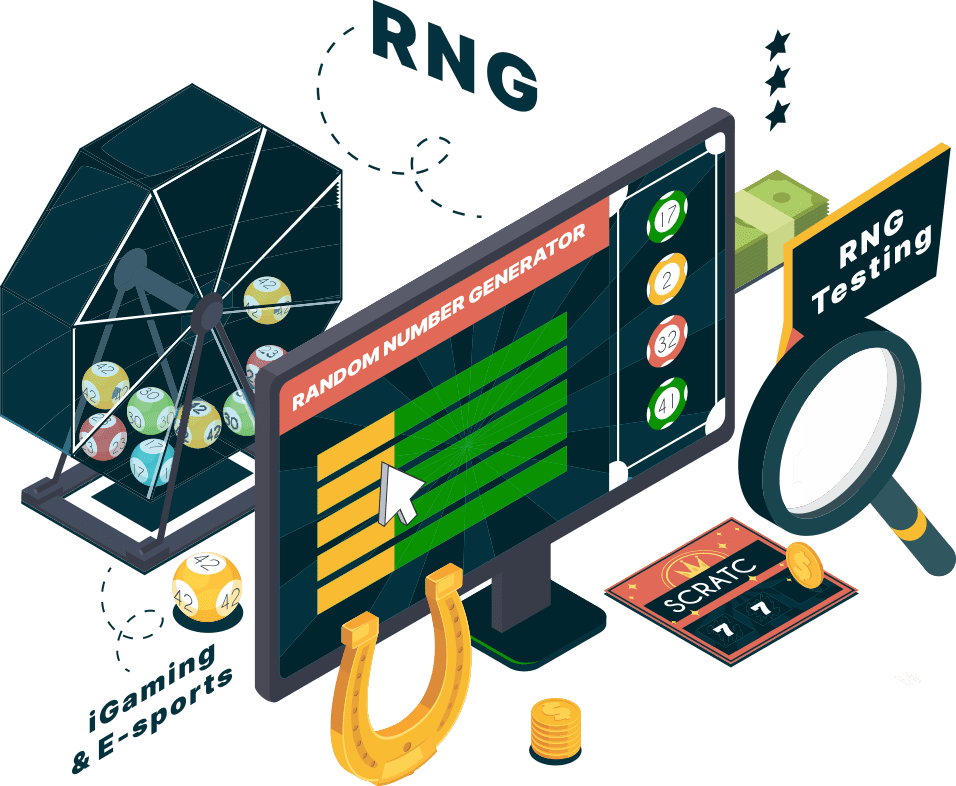



Comprehensive Evaluation
Customized Software Tools
We deploy custom software designed by our in-house experts to conduct thorough evaluations. These tools are refined over time and validate randomness, perform calculations, and generate graphical representations during assessments.
Gaming Associates’ Random Number Generator (RNG) evaluation consists of verifying of the following:
- Statistical randomness
- Internal state of the RNG
- Seeding, re-seeding and cycling
- Unpredictability and non-repeatability
- Usage of random numbers including scaling and shuffling
Detailed RNG Testing Aspects
Our evaluations cover key aspects: